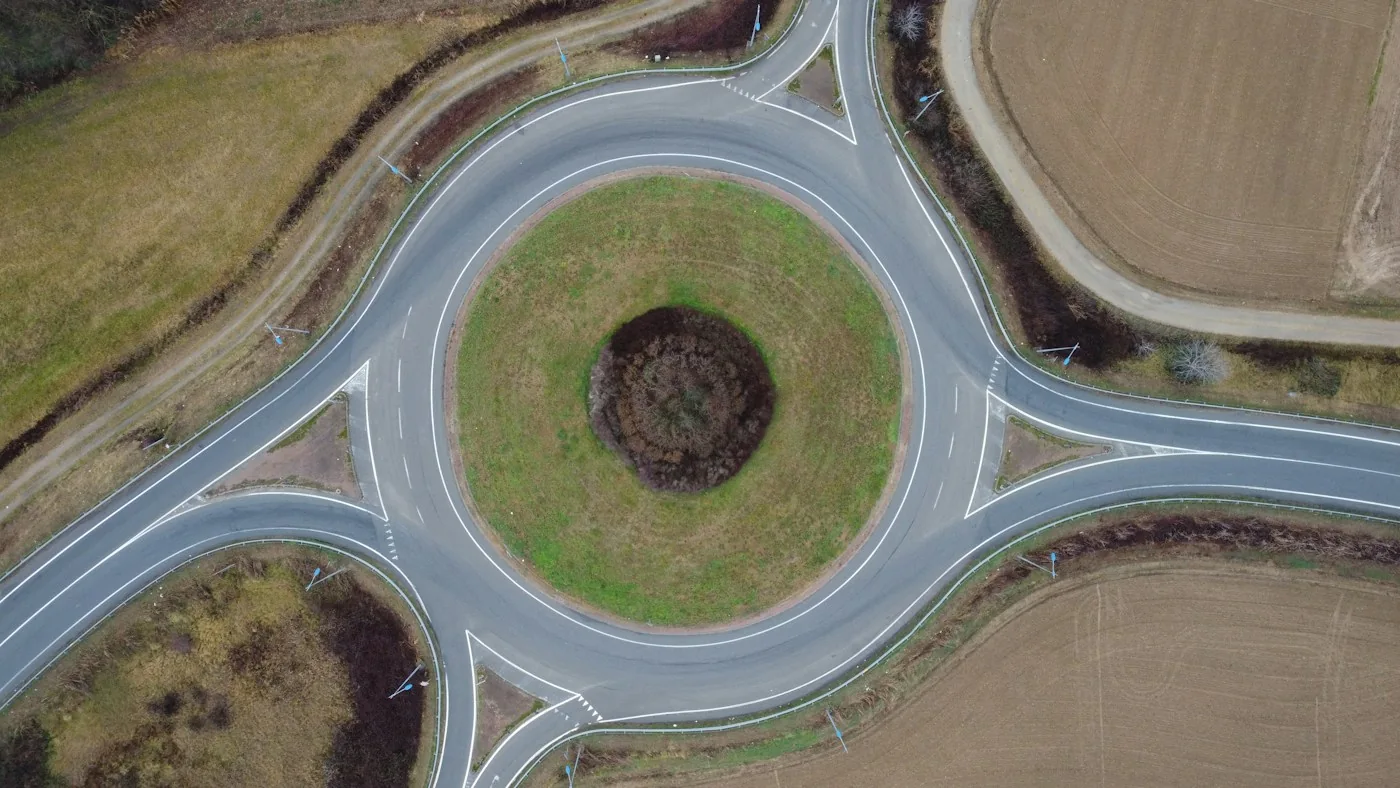
Start with the approach, not the island
The central island is the most obvious part of a roundabout, but the approach helps explain how it works. The Texas Department of Transportation describes modern roundabouts through a combination of yield-at-entry operation, slower speeds, and curved geometry. The path directs vehicles into the circulating roadway rather than treating the intersection as a straight crossing.
In the United States, circulating traffic moves counterclockwise and entering vehicles yield to traffic already there. The important general lesson is that the design uses shape to communicate behavior. It does not rely on a circular appearance alone.
Similar silhouettes can hide differences
TxDOT describes mini, single-lane, and multi-lane configurations, as well as features that depend on the site. A photograph of one roundabout should therefore not become a universal guide to another. Lane arrangements, crossings, and signs need to be read in their own setting.
For drivers, cyclists, and pedestrians, the practical instructions are the current local rules and the layout in front of them. An explainer can introduce the idea without replacing those instructions. Keeping that distinction clear makes the article more useful and avoids treating a diagram as a driving lesson.
Read a plan as a set of paths
When looking at an official overhead plan, trace one user at a time. Follow a vehicle path, then look separately at the pedestrian route and any cycle provision. Find where each begins, where it waits or yields, and where it leaves the area. Do not let the neat central circle distract from those connections.
This is a good way to approach many street plans. A design can look simple when everything is viewed at once and become more interesting when each journey is followed in sequence. The edges and approaches often contain the information that the overall shape conceals.
Ask how the design will be explained
For a proposed local change, look for public information that shows the exact layout and explains how different users will navigate it. Ask what problem the project is meant to address and what evidence will be used afterward. A familiar success story from another location can provide context without settling every question about this site.
Roundabouts make an everyday form of design visible: arranging a path can influence the pace at which a person encounters a decision. The central island may be attractive, but the curved approach carries much of the message. Reading the intersection that way turns it from a symbol in a traffic debate into a specific collection of movements, signs, and spaces that can be examined on their own terms.
Sources & further reading
Source links provide context for this original feature. Illustration is not documentary evidence of a specific event.